
The Right-Angle Gear Dilemma: Worm vs. Bevel—Which Trade-Off Wins?
Worm Gears vs. Bevel Gears: Which Trade-Off Are You Willing to Make?In right-angle power transmission, the question isn’t “Which is better?” — it’s “What compromise fits your application?”
Here’s how I evaluate it:
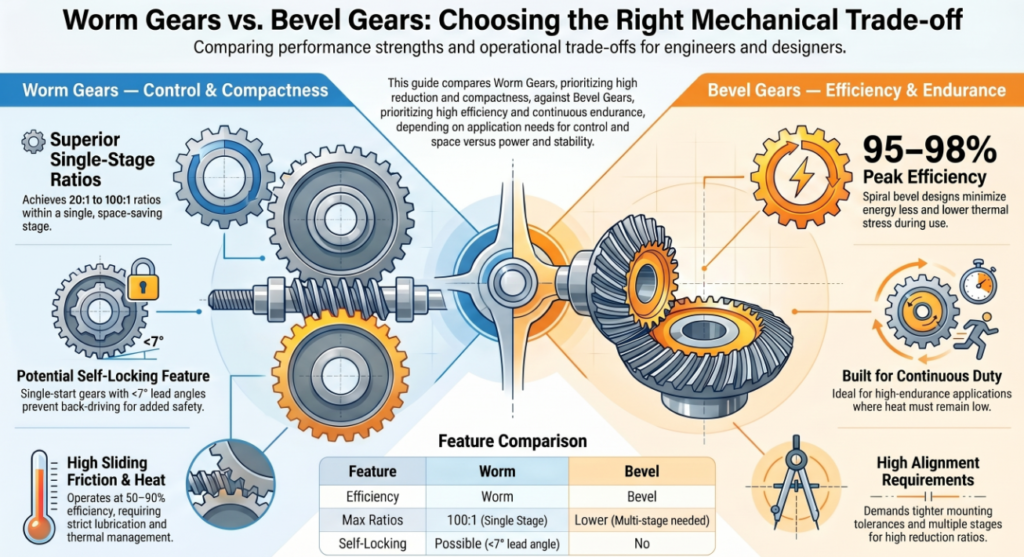
Worm Gears — Control & Compactness
Best when you need:
– High single-stage ratios (20:1–100:1)
– Compact design
– Potential self-locking (only single-start, <7° lead angle)
Trade-offs:
- 50–90% efficiency
- Heat from sliding contact
- Strict lubrication requirements
Bevel Gears — Efficiency & Endurance
Best when you need:
- 95–98% efficiency (spiral bevel)
- Continuous duty
- Lower thermal stress
Trade-offs:
- No self-locking
- Tighter alignment requirements
- Multi-stage needed for high ratios
Key Insight:
For hoists or positioning systems, controlled back-driving may justify worm gears. For long-duty industrial drives, efficiency losses compound quickly.
What drives your selection — safety, efficiency, or lifecycle cost?
MechanicalEngineering #GearDesign #PowerTransmission #IndustrialGear#RingGear #WormGears #BevelGears