
Spur or Helical Gearbox? Stop Overcomplicating Your Industrial Drive System Selection
After optimizing drive systems for heavy industrial equipment over many projects, one truth stands out: the practical difference between spur and helical gearboxes lies not in textbook theory, but in real-world working conditions.
Below are the core practical factors you need to evaluate when selecting industrial gearboxes:
* Noise and Operation Smoothness
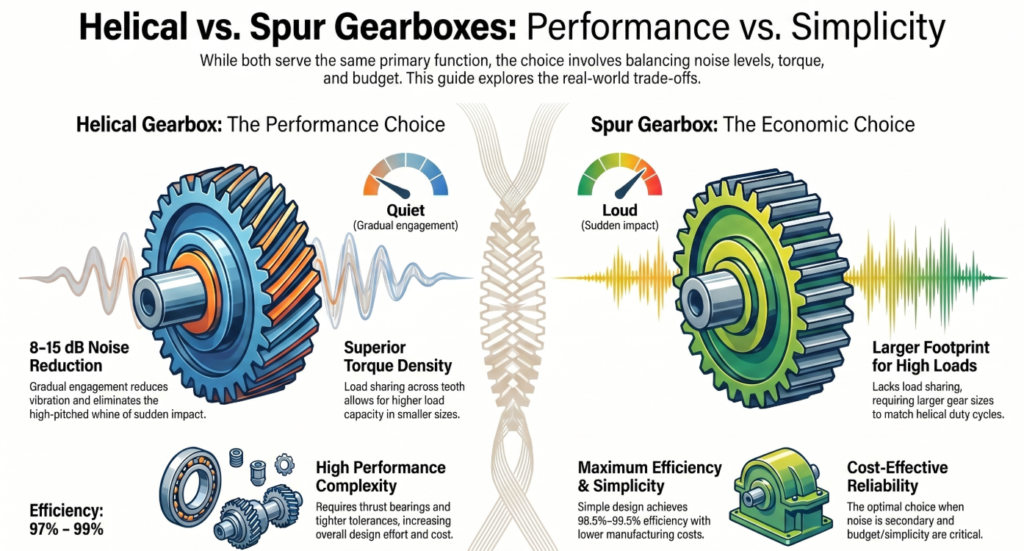
Helical gears achieve gradual tooth engagement, lowering operating noise by 8–15 dB and minimising system vibration. Spur gears produce instantaneous tooth impact during meshing, resulting in the typical high-pitched gear whine.
* Load Bearing Capacity
Helical gearboxes provide higher torque density thanks to distributed load sharing between gear teeth. To achieve equivalent load performance, spur gearboxes require larger overall dimensions.
* Transmission Efficiency
Spur gearboxes hold a minor efficiency advantage, reaching 98.5–99.5%, compared to 97–99% for helical gearboxes. Nevertheless, advanced modern helical gear designs have greatly closed this efficiency gap.
* Manufacturing Cost and Design Complexity
Spur gearboxes benefit from simpler structure and lower procurement costs. Helical gear configurations demand thrust bearings and stricter machining tolerances, pushing up component costs and engineering workload.
#Gearboxes #MechanicalEngineering #PowerTransmission #IndustrialGears #HelicalGears #RingGears