
Industrial Lubrication Tips to Extend Wastewater Gearbox Service Life
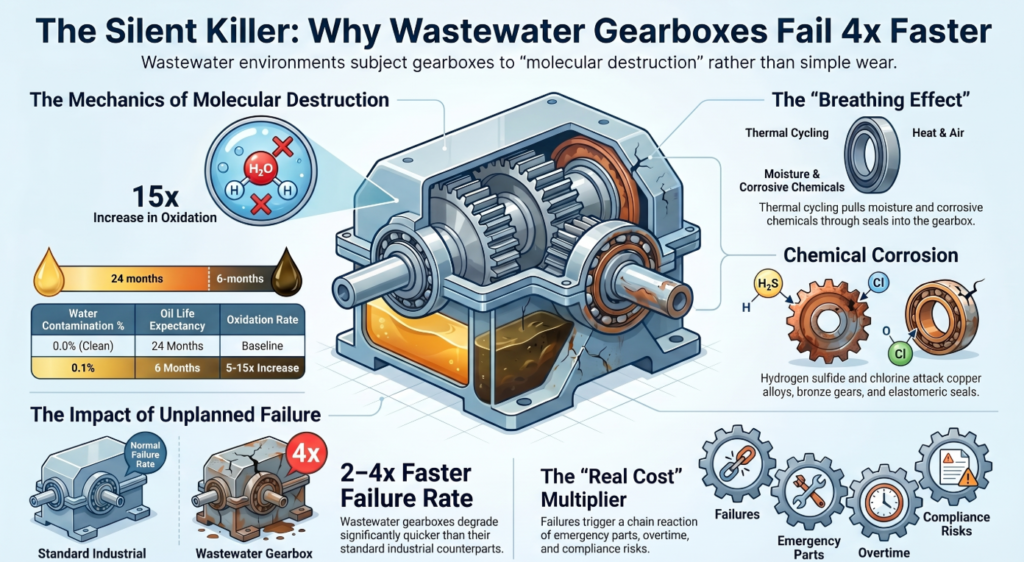
Wastewater gearboxes consistently fail 2 to 4 times faster than standard industrial gearboxes, and simple oil dilution is not the core cause—persistent molecular-level component destruction driven by harsh wastewater operating environments is the key culprit. This premature equipment failure plagues most wastewater treatment facilities, causing unplanned downtime and high operational costs.
Even minimal water contamination triggers severe lubricant degradation. A mere 0.1% water content in gear oil accelerates oxidation by 5–15 times, cutting standard 24-month lubricant service life down to just 6 months. Beyond oil damage, hydrogen sulfide (H₂S) in wastewater corrodes copper alloy bearings and bronze gear components, eroding core mechanical structures. Frequent thermal cycling creates a gearbox “breathing effect”, pulling external moisture through seals and worsening internal contamination. Additionally, chlorine and polymer chemicals in wastewater degrade elastomeric seals, creating permanent leakage and contamination loopholes.
Unplanned gearbox failures bring massive hidden costs, including emergency part replacements, staff overtime, production downtime, and regulatory compliance risks. Standard commodity gear oils cannot withstand wastewater’s corrosive conditions. Application-specific engineered lubricants with advanced water separation and corrosion inhibition act as critical equipment insurance, drastically reducing failure rates and stabilizing facility operation.
WastewaterTreatment #GearboxMaintenance #AssetReliability #IndustrialLubrication
#IndustrialGearboxMaintenance #WaterContaminationInLubricants