
Bevel Gear Pros and Cons: When to Use (and Avoid) This Traditional Gear
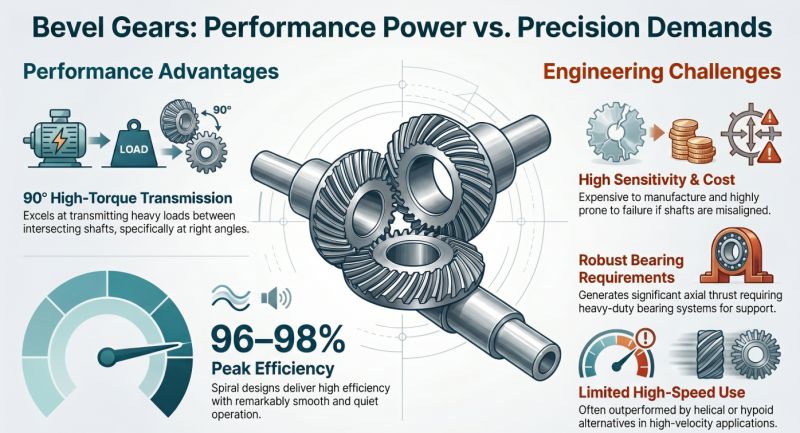
Bevel gears have long served as a traditional staple in power transmission systems, yet modern mechanical designers constantly question whether they remain the optimal solution for contemporary applications. Renowned for transmitting high torque between intersecting shafts—most commonly 90-degree configurations—bevel gears are irreplaceable in specific industrial scenarios. Spiral bevel gears stand out with exceptional 96–98% energy efficiency, delivering ultra-smooth, low-noise operation that boosts overall equipment stability.
Despite their classic advantages, bevel gears present notable drawbacks that limit widespread modern adoption. Their complex manufacturing process leads to high production costs, while the gears are extremely sensitive to shaft misalignment, raising installation and maintenance requirements. Additionally, they generate strong axial thrust, necessitating heavy-duty, robust bearing systems to support stable operation. In high-speed industrial applications, helical and hypoid gears often outperform bevel gears with better stability and lower loss.
The core design principle is clear: bevel gears are not a universal default. Engineers must conduct comprehensive system-level analysis to evaluate application scenarios. Only high-torque, intersecting shaft transmission projects can justify their cost and structural complexity, while alternative gear types deliver better efficiency for most high-speed and precision scenarios.
#BevelGears #MechanicalPowerTransmission #IndustrialGearDesign #SpiralBevelGear #GearProsAndCons #HighTorqueGears #MechanicalEngineering #GearSystemOptimization #HelicalVsBevelGear #IndustrialMechanicalComponents