
Spur vs Helical Cylindrical Gears: Choosing the Right Cylindrical Gear for Your Application
Cylindrical gears are the core power‑transmission component for nearly all parallel‑shaft industrial systems, yet overall equipment performance heavily relies on correct gear geometry selection. Mis‑matched gear choices often lead to excessive noise, premature wear, vibration failure and unexpected downtime.
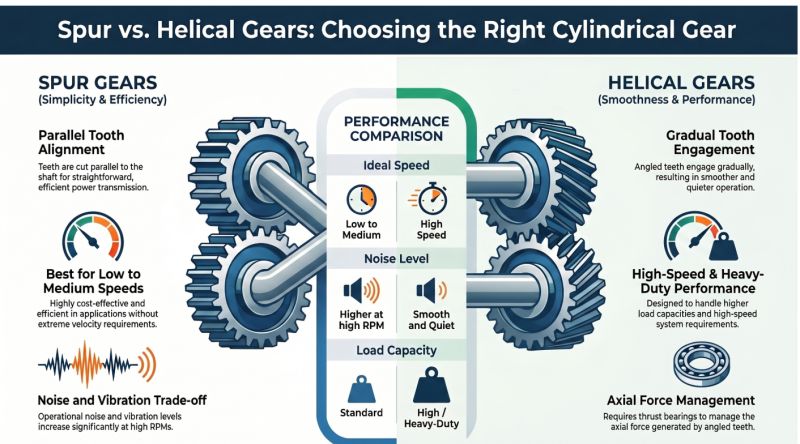
Spur gears feature teeth running parallel to the mounting shaft. This straightforward design delivers high efficiency and competitive cost‑effectiveness. They work perfectly for low‑to‑medium speed operating conditions. The main limitation emerges under high RPM operation, where spur gears generate elevated noise and vibration levels.
Helical gears adopt angled gear teeth to enable gradual tooth engagement during rotation. This design delivers smoother running performance, lower noise output and greater load‑carrying capacity. Helical gears are the preferred solution for high‑speed and heavy‑duty transmission setups. One critical design note: helical gears produce axial thrust force, so thrust bearings must be incorporated within the system layout.
Involute tooth profiles remain the industry standard because they sustain stable constant velocity while tolerating minor center‑distance deviations, which is essential for precision machinery. Key structural components include the rim for structural strength, teeth for power transfer, the web for weight optimisation, plus hub and bore for reliable torque delivery.
Effective gear selection cannot focus solely on purchase cost. Engineers must evaluate combined factors: applied load, operating speed, allowable noise threshold and supporting bearing configuration to achieve long‑term reliable transmission performance.
#SpurGear #HelicalGear #CylindricalGear #ParallelShaftGear #IndustrialGearTransmission #GearDesign #InvoluteTooth #HeavyDutyGears