
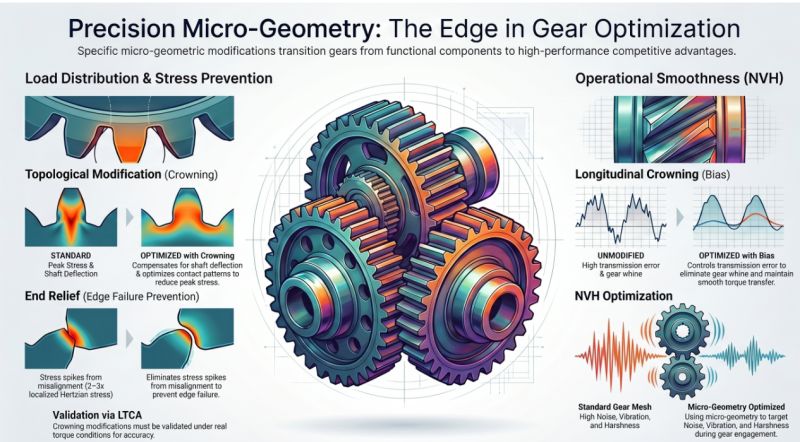

Standard gears deliver basic functionality, while micro-geometry optimized gears create lasting market competitiveness. For industrial gear systems, the core gap between theoretical design and real-world field reliability lies in precision micro-geometry tuning, which defines gear durability, load capacity, and NVH performance.
Professional micro-geometry optimization covers three core high-performance modifications for premium gear operation. First, topological crowning compensates for shaft and bearing deflection under operational loads, accurately optimizes gear contact patterns, and eliminates peak stress to prevent micropitting damage. Long-term load cycle analysis (LTCA) under real torque conditions is mandatory to validate its stability.
Second, gear end relief effectively eliminates extreme stress spikes caused by assembly tolerances and misalignment, reducing localized Hertzian stress by 2–3 times. This modification is indispensable for heavy-load gear systems, drastically lowering edge failure risks and extending service life.
Third, longitudinal crowning (bias) targets NVH optimization, controlling gear transmission error—the primary source of gear whine. It ensures stable, smooth torque transfer even when components deflect under load.
Gear micro-geometry is not a minor technical refinement but a critical bridge between calculated design capacity and real-world operational dominance. Precision micro-geometry tuning enables gear systems to maintain consistent, reliable, low-noise, and high-durability performance in complex industrial scenarios.
GearDesign #PowerTransmission #MechanicalEngineering #GearBox #ReliabilityEngineering