
Helical vs. Spur Gears: Which Geometry Optimizes Torsional Vibration and Load Distribution?
Selecting the right gear type is critical for mechanical system performance, service life, and operational noise. Many engineers face a common decision: helical gears or spur gears. Understanding their core differences helps you pick the optimal solution for your industrial equipment.
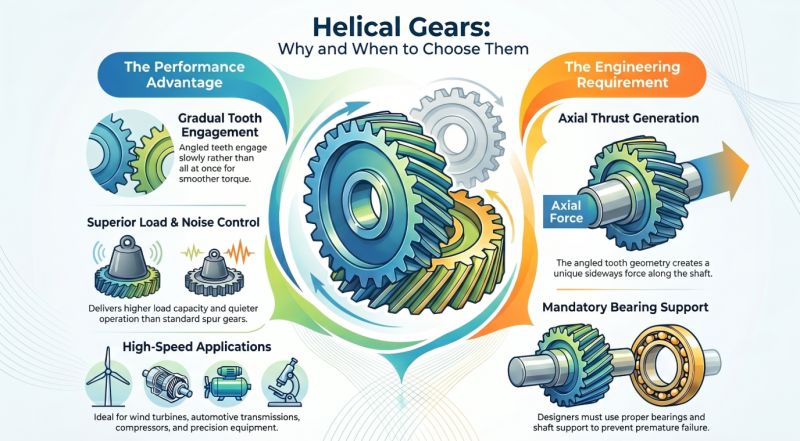
Helical gears stand out for smooth operation, high‑speed running capability, and low‑noise output. Unlike spur gears with straight teeth that mesh fully at one instant, helical gears feature angled gear teeth that engage gradually during rotation. This geometric difference brings tangible mechanical advantages.
Gradual tooth engagement improves overall load‑carrying capacity, cuts down system vibration, delivers stable torque transfer, and greatly reduces operating noise. These strengths make helical gears widely adopted across many heavy‑duty and precision‑focused industries. Typical real‑world applications include wind turbine gearboxes, automotive transmission assemblies, industrial compressors, and high‑accuracy precision machinery.
Even with obvious performance benefits, helical gears come with one major design limitation. The angled tooth profile creates inherent axial thrust force during operation. Equipment designers must compensate for this thrust by installing suitable bearings and robust shaft support structures. Without proper structural design, components will suffer excessive wear and premature unexpected failure.
As a practical rule of thumb for gear selection: go with helical gears when you prioritize high performance, low noise and long‑term reliability over simple manufacturing and lower upfront costs.
Spur gears remain a cost‑effective alternative. Straight‑tooth spur gears work perfectly for low‑speed, low‑load working scenarios where noise and vibration are not primary concerns. They have simpler structure, easier assembly and lower production costs.
Every project has unique operating conditions. Evaluate speed, load, noise requirement and budget before finalizing between helical gears and spur gears for your mechanical design.