
How Do Internal Gears Cut Volume While Boosting Torque in EV and Robotic Applications?
Many mechanical design engineers face persistent bottlenecks: tight space constraints and strict torque‑output limits that block compact‑drivetrain innovation. If you keep running into these design barriers, it may be time to re‑evaluate the performance advantages of internal gear systems.
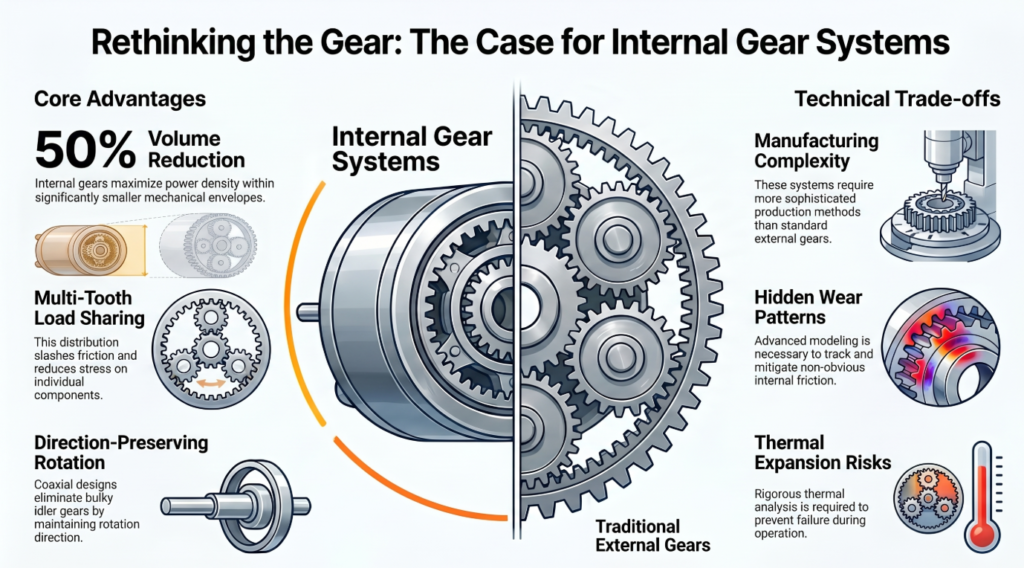
External spur and helical gears remain the mainstream industry standard for most transmission projects. Even so, internal gear setups are powering cutting‑edge modern hardware, ranging from electric vehicle hub motors to high‑load robotic joints. Well‑optimized internal gear assemblies can deliver up to 50 % reduction in overall system volume compared with equivalent external‑gear drivetrains, making them ideal for space‑critical equipment.
Multiple core benefits make internal gears worthy of serious design consideration. First, improved efficiency comes from multi‑tooth load sharing, which effectively lowers surface friction and disperses mechanical stress across more contact points. Second, the coaxial layout maximises torque output inside extremely compact physical envelopes, a huge advantage for miniaturised machinery. Third, inherent direction‑preserving rotation removes the requirement for large, heavy idler gears, simplifying overall transmission architecture and cutting part‑count.
Engineers must also address well‑known drawbacks before deployment. Internal gears bring higher manufacturing complexity, difficult‑to‑predict hidden wear patterns, and performance shifts caused by thermal expansion. Reliable, rigorous multi‑physics modelling is essential to avoid premature component failure.
The practical takeaway is clear: internal gears deliver enormous spatial‑saving and torque benefits for compact mechanical designs. Real‑world success depends on intentional engineering that accounts for manufacturing tolerances, material selection, and thermal‑expansion constraints during the early design phase. For EV, robotics and heavy‑duty compact transmission projects, internal gear technology opens valuable new design possibilities.
internal gears, compact mechanical design, high torque transmission, EV hub motor gear, robotic joint drivetrain, gear system efficiency, coaxial gear design, gear manufacturing constraints, transmission space optimization, mechanical engineering innovation