
Why Do Gears Fail Prematurely Even With Good‑Quality Steel?
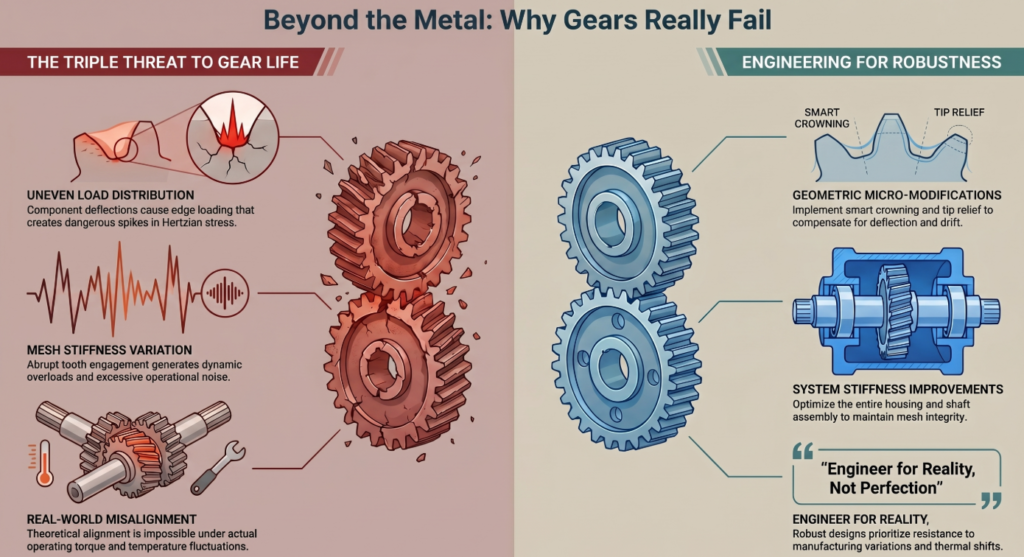
Most gear failures happen long before the base material reaches its limit. Poor steel strength is rarely the culprit. Instead, real‑world operating conditions‑misalignment, component deflection, and improper lubrication‑generate local stresses exceeding original design expectations.
Three underestimated mesh factors trigger most premature gear damage:
1. Load Distribution: Deflection leads to edge loading and sharp Hertzian stress rise.
2. Mesh Stiffness Variation: Sudden tooth engagement brings dynamic overload and excessive noise.
3. Loaded Alignment: Zero‑imperfection alignment cannot exist under real torque and temperature.
Robust gear design does not pursue ideal theoretical status. It accounts for manufacturing tolerances, deflection and thermal drift by applying crowning, tip relief and optimizing system stiffness.
Have you met mesh‑related troubles such as edge loading, noise, scuffing or poor contact patterns in practical projects?
GearDesign #MechanicalEngineering #Gearbox#PowerTransmission #RingGears